
Activité récente

I can so relate to these posts. yesterday my thoughts turned, once again, to losing more lawn and my increasing disinterest in perennials. I enjoy the scale, textures and permanence of trees and shrubs more and more. Ive always incorporated woodies into my garden but now i want them to be foreground, not background. yesterday i had a brainstorm to remove the 15 or so June hostas from under the fringe tree and replace with …..what? Something with fall color, rabbit, deer resistant, shade tolerant- low grow sumac? This will keep me up at night for weeks. Or just bedding impatients? The cost of a new tree could keep me in annuals for a decade.
It is good to ruminate about these things with gardening companions (of long standing)instead of reading prescriptive magazine articles. I too am in my 7th decade.
marie
porkchop, yes! This! It's why I have about 8 potted shrubs sitting in my yard as I decide what and where to put them!
My issue is time. I've always been short of enough time to really do what I'd like in the garden, and since my little girlies arrived 4 years ago, I have so much childcare duty that my time is even tighter. Then this year I had a knee issue and lost over two months in the garden! Yikes, it's a jungle out there! Literally lol.
So I am putting in evergreens and flowering shrubs. Or at least I plan to lol. First step is to finally decide WHAT, then WHERE, and then - the hardest part - a) restrain myself from buying too many more perennials and b) stop sowing 100 jugs of annuals! I guess I can cut down on my dahlias too.
Anyway, no time at the moment (haha of course not!) to fully read this thread but hope to come back and read it all and commiserate and join in again. But when I saw your post I HAD to respond because this has been my plan for the last few years!
:)
Dee
This thread is an echo chamber for me, lol! Everything you each wrote describes me well, except for turning more to tree/shrub installation. My 3 acres have far too many mature oaks, maples and pines to warrant any more big trees. Then there's the huge river birch I planted 25 years ago, and the crabapple and Japanese maple ditto. Bridal Wreath, lilacs, roses, High bush blueberries, a hedge fo inkberry. And others...
Since I became an octogenarian a couple of months ago, I am also struggling with my growing lack of interest anad strength, generally, and my inability to attack my gardens the way I once did. Most frustrating! But I am trying to deal with aging and to not overdo things which always end up in pain. Silly woman, it's time to be more mindful before I do myself an injury!
This year I allowed the front lawn to become the start of a "meadow" by not mowing a large section of it and letting Mother Nature have her way: Black-eyed Susan, Queen Anne's Lace, forget-me-nots, taller grass growth, some native asters -- none planted by me. And the result was decently pleasing - to me AND to many, many more bees & butterflies than I have seen for several years. Just what I'd hoped would happen. =) I'm not lazy, just trying to help the environment here!

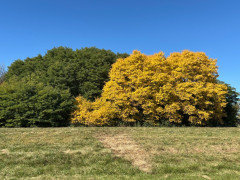
I've been watching this stand of black locust along the interstate for a number of years, and the section to the right (which is clearly a different clone from the rest) consistently turns yellow in September, and then drops its leaves while the rest of the stand is still green. Photo 9/29/26:

Shagbark is going to be very slow, especially the first several years. Cucumber magnolia is considerably faster, but probably more finicky to cultural conditions. How patient are you and which one will do best in your conditions?
I can find seeds sourced from Iowa (not sure where) and close to Binghamton , NY. Seems that anywhere in iowa is colder than that area of NY. so Iowa it is

Plant them where you want them, as hickories are not easy to transplant because of the tap root (tho I've done it successfully).
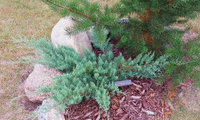
It’s looking good! What is the pine (?) growing next to it? Banksiana?

Originally planted as a possible 'dwarf' seedling, and was not, the P. banksiana is located where a 'Windbreak/Snow Fence' is needed anyways, so it turned out good.
The pine appears to be a long ways from the covered Hemlock in the back but is only a little over 20ft. between them and the snow piled up extra deep there last winter, which in imo, helps the overall cause. 😉
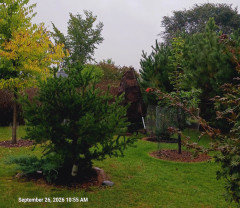
In the wild, many trees begin life in the understory of the parent trees.
When I first started planting here, in my treeless yard, all of my plantings suffered to some extent, under direct, all day (<=15 hrs) sun.
Everything I've planted more recently, is doing better now that many of my originaly planted trees are large enough to produce a certain amount of shade at various times of the day.
It will be interesting to see how well the little abies will handle the dense, established root system of a mature white pine.
I too am a bit skeptical about how it will perform under this pine. If adequate moisture is the test, then I think it will work — at least in the relatively short run (5-10 years). If other factors (i.e. root congestion) come into play, then it will likely be a failed experiment. It could all be moot if deer find it to their liking. The good news is Abies are generally not their favorite browse.
I’d grow it for the foliage…if I could…which I can’t. I miss Ken.
This is purely out of curiosity, but how does it do in Portland? What would you expect the growth rate to be? Maximum expected height?
I researched Machilus thunbergii in the past, since I was interested in broadleaf evergreen trees that could grow in the Pacific Northwest (climate zone 8 ).
It is actually native to Japan. But in Japan, it is sort of seen as an "inferior" version of camphor tree. However, Machilus thunbergii is more cold tolerant than camphor tree, and can grow in colder parts of Japan; although the majority of the population in Japan (such as in Tokyo) lives in areas where camphor trees can grow.
The foliage of Machilus thunbergii reminds one a little bit of some Chinese evergreen magnolia trees (which are rare in cultivation, but not completely unheard of in the U.S.)
There is also "Japanese cinnamon" tree (Cinnamomum tenuifolium) for anyone who is interested (though it is a smaller tree, and evergreen leaves not as pretty).

I don't know why the Japanese would complain - they have plenty of BLEs and a summer wet climate that supports them. The hardiest Cinnamomums are surely as hardy as any Machilus, but they might not be commonly cultivated in Japan. It's actually a little surprising that Japanese gardeners (vs. forest managers or whatever) like camphor trees, because they get so gigantic! I think of gardens there as being smallish.
Honestly, on showiness alone, the flowering Castanopsis of Japan might be prettier than any Cinnamon or Avocado family member! I ONCE AGAIN failed with the Castanopsis seeds Sheffield was offering...not sure what I'm doing wrong, and feel like an idiot at this point. At least I got some other rarities to germinate, like Pinus gerardiana, and Nomocharis aperta. 3 out of 15 seedlings survived in trays this summer, so hopefully I've selected a 'heat tolerant' clone of that Himalayan beauty! (the lily seed was from Jelitto, not Sheffields)
"we're very lucky to live in a place where anything will grow, whether it likes water or not. For those types that need regular water, just add it and stand back!".
Yeah, now, I'm 'used to' a summer wet (usually) climate, which isn't to say I'm not jealous of what people can grow in the PNW. But the problem with a summer wet climate is you can't turn it off! The reason one saw rhododendrons growing near the bottom of swales at Greer Gardens, (or Sonoma Hort for that matter) where they would never be able to survive around here, isn't JUST the cooler nights in summer...it's that because any summer water is water you're turning on, yourself, there's no way to drown them as can happen around here after a hurricane. As I've said before, around Hurricane Irene in 2011, I got close to 30 inches of rain in 40 days. It did kill a few rhododendrons (including a big gorgeous R. rex I'd driven across the country from RSF) but fortunately, most of mine are planted on a gentle slope and it prevented an absolute carnage. They get just enough drainage help from that. This was really a happy accident, when I bought this lot in 2006, I had no idea I'd get 'smitten' by rhodies by driving to Rarefind in NJ that spring. I never knew you could have an 'english looking' rhodie garden in the eastern US. (FWIW Rarefind was on pine barren sand, and had a very sophisticated irrigation system with a deep well and large pump house, so actually closer in that respect to the PNW, than my garden.)
OH well, sorry to take over the thread, but it's interesting to compare gardening practices PNW vs. East coast. I love the summers I can coast by without having to water a damn thing even once, even newly planted stuff. But we pay the price when the spigot won't shut off! (And of course, have to water in dry summers like 2024 and 2025.)
@maackia Yes, mine looks like yours, although the crown in mine is much denser than yours, i.e. the incursions in the crown is much smaller than in yours. However, seeing yours, I see that I have to start cleaning out at the incursions and work my way through the inside of the whole crown.
Well, when I see the buds start growing in spring next year, I will do the job. Wish me lots and lots of patience!
Good luck with it, and I hope you’ll share some pictures on your pruning adventure.